
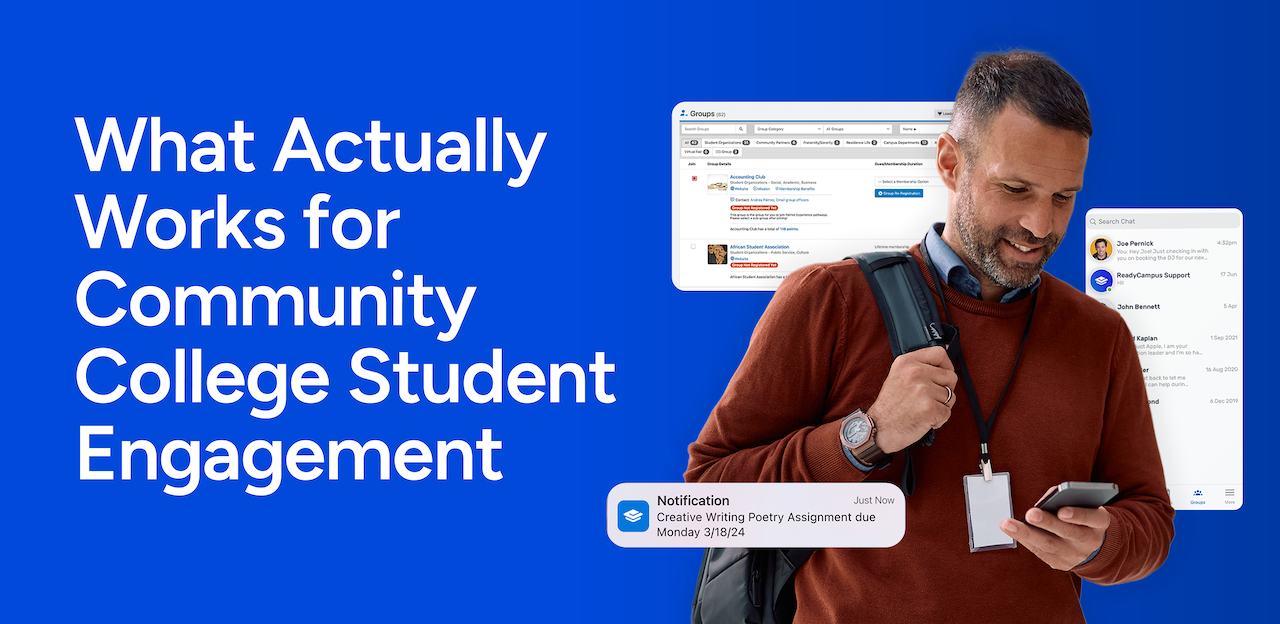
Community college students are not disengaged. They are busy. They are working full-time jobs, raising children, managing long commutes, and navigating college while balancing responsibilities that never pause. And yet, institutions are still asking the same questions: How do we build belonging? Improve persistence? Engage students who do not have time to engage?
We spoke with student affairs leaders from Portland Community College, Madison Area Technical College, and Salt Lake Community College to find out what is actually working. Here is what they shared.
The Problem: Traditional Engagement Was Built for a Different Student
At most four-year residential institutions, engagement is built around the assumptions students spend large amounts of time on campus. Community colleges rarely have that luxury.
The traditional playbook of flyers, tabling events, and club fairs assumes students will seek out opportunities on their own. But a student with 40 minutes between class and a shift does not have time to find your flyer. She is already heading to her car.
The institutions making progress on engagement have moved away from waiting for students to come to them. They are redesigning around where students actually are.
What’s Working at Community Colleges: Five Lessons from Three Campuses
1. Go to students instead of waiting for them to come to you
Portland Community College runs what they call “Panther Prowls.” Student engagement leaders load a wagon with snacks and information and travel to wherever students are, including CTE buildings on the far end of campus that most students never visit for anything other than class.
The lesson is not the wagon itself. It is that access design matters as much as program design. If participation requires students to seek something out, most of the students you are trying to reach will never find it.
2. Family-friendly design is not optional
Madison College has on-site childcare at multiple campuses, family study rooms that accommodate kids of all ages, and a children-on-campus policy that signals to student parents that they belong here. This fall, they are piloting drop-in childcare to address the inevitable moments when arrangements fall through.
If attending an event means having to find childcare, student parents will not attend. Designing for families is designing for participation.
Madison College has also made many student leadership roles paid positions. Asking students who are working to pay rent to volunteer their time is a barrier. A stipend changes the math.
3. Gamification works when it reinforces what students should already be doing
Portland Community College’s Drive to Thrive program attaches points to activities connected to student success: advising visits, tutoring sessions, and career services appointments. Accumulate enough points, and students are eligible for real prizes, including a car.
The model does not invent new behaviors. It makes existing ones visible, trackable, and rewarded. And it runs through the platform automatically, so staff do not have to chase participation manually.
4. Data turns engagement from a feeling into an argument
Madison College has been tracking engagement against student outcomes for years. Their most recent fall data: students involved in a student organization completed 94% of enrolled credits, compared to 88% for uninvolved students. Involved students held a cumulative GPA of 3.26 versus 2.59 for uninvolved students.
Those numbers change conversations with institutional leadership. The difference between knowing engagement matters and being able to prove it is the difference between a budget request that gets funded and one that does not.
5. Multi-campus institutions need centralized infrastructure
Salt Lake Community College (SLCC) operates across seven campuses. Portland Community College has four. Without a way to filter events and clubs by location, students at smaller campuses may feel like they are attending a lesser version of the institution.
SLCC rebuilt its programming model to ensure every campus had access to the same high-quality student experience. That required both leadership buy-in and a platform that could support decentralized programming without losing coherence.
Engagement Is a Retention Strategy
This came up repeatedly across all three institutions, and it is worth stating directly.
Student engagement is not a nice-to-have. It is a retention mechanism. Students who are connected to campus, who have a club, a leadership role, a reason to come back, persist at higher rates, complete more credits, and return the following semester.
Community colleges serve the most diverse student population in American higher education: first-generation students, students of color, adult learners, and student parents. For many of them, belonging is not a given. It has to be built. As one practitioner put it: “A student’s not going to be involved if they’re hungry.” Basic needs support, accessible programming, and community infrastructure are not separate from engagement. They are part of it.
For many students, feeling connected to campus is the difference between stopping out and staying enrolled.
The Cost of Standing Still
Most student affairs teams already know their engagement model is not reaching everyone it should. The students slipping through are not invisible. They are the ones who completed one semester and did not come back, the ones who never joined anything, the ones who never felt like this was their campus.
The institutions making progress are not exceptional because they have more resources. They got here because they decided the old model was not working and built something different. That work is available to any institution willing to start.
Learn how community colleges are using CampusGroups to support belonging, engagement, and persistence.