
Business schools continue to invest heavily in the student experience. They build support services, hire dedicated staff, and design programs with care and intention. The challenge is no longer effort; it’s alignment.
Business school communication habits have not fully evolved alongside how students consume information. This leads to fragmentation, missed connections, and inconsistent engagement. To better understand this shift, Ready Education partnered with AMBA & BGA to survey business school leaders worldwide.
The findings highlight what the future of student communications looks like. We also go one step further and underscore how leading schools are modernizing student communication.
1. Mobile-First Student Experiences Are Becoming the Standard
76% of business school leaders say students primarily access university information on mobile devices. However, only 28% describe their communication experience as mobile-optimized.
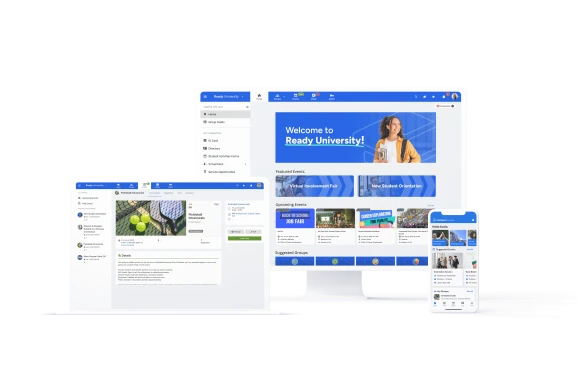
Leading institutions are closing this gap by prioritizing mobile-first design. This ensures that students can access key information, including schedules, events, deadlines, and resources, instantly, wherever they are.
2. Centralized Communication Helps Eliminate Information Overload
Rather than managing communication across multiple disconnected systems, leading schools are moving toward a single source of truth.
This shift is critical given that:
- 47% of institutions lack a unified communication hub.
- 57% say students receive conflicting messages from different departments.
- More than half report information overload as a real problem for students.
Students are juggling multiple systems, channels, and message streams just to stay informed, which has consequences such as:
- Missed deadlines.
- Missed events.
- Reduced engagement.
- Lower sense of belonging.
Consolidating business school communications into a single, connected environment reduces noise, improves clarity, and makes it easier for students to stay engaged and successful.
3. Multi-Channel Strategies Are Aligning with Student Behavior
95% of institutions rely on email, even though only 18% say it is the channel students engage with most. Students are increasingly active on messaging apps, mobile notifications, and social platforms.
In response, leading business schools are evolving toward multi-channel strategies that meet students where they are, not where systems were originally built. The result is more timely, relevant, and accessible communication.
4. Real-Time Engagement Data Is Enabling Proactive Student Support
70% of respondents believe student dropouts are preventable. Forward-looking institutions are acting on this belief by adopting real-time engagement data to identify disengagement earlier in the student journey.
However, 63% still do not systematically use engagement data for proactive intervention. Schools that do are shifting from reactive support models to proactive student success strategies, identifying risk before academic performance declines. They are using real-time engagement data to proactively identify at-risk students. For interventions to facilitate student success, timing matters.
5. Co-Curricular Data Is Becoming a Core Part of Student Success Strategy
Institutions increasingly recognize that co-curricular engagement is essential to building a sense of belonging, retention, and career readiness. But most still struggle to measure it effectively:
- 49% do not use co-curricular transcripts.
- 67% cannot easily connect engagement data to outcomes.
Leading business schools are investing in systems that capture co-curricular participation more effectively. The co-curricular transcript enables student affairs teams to demonstrate impact, secure funding, support student development, and align engagement with long-term success.
The Future of Communication: Connected, Mobile, and Data-Driven Engagement
Across all five areas, a clear pattern emerges. The most effective institutions are not simply communicating more; they are communicating more intentionally.
Concretely, they are:
- Centralizing communication into one source of truth.
- Designing mobile-first student experiences.
- Using real-time engagement data to act earlier.
- Aligning communication across departments and channels.
- Connecting co-curricular engagement to student outcomes.
Leading business schools are already making this shift.
ESCP Business School consolidated fragmented systems into a unified student engagement hub through CampusGroups. This resulted in doubling the number of active users in one year and centralizing engagement across 193 student societies.
IE University built a connected student-to-alumni ecosystem across 130+ nationalities using CampusGroups. This led to increased engagement through personalized, data-driven communication and sustained community interaction.
Both institutions recognized the same issue: fragmented tools create fragmented student experiences. The schools making the greatest progress are not necessarily communicating more. They are communicating more clearly, more centrally, and through the channels students actually use.
About the Survey
This survey was conducted by Ready Education in partnership with AMBA & BGA. Responses were gathered from 93 business school leaders across Europe, Latin America, the UK, Africa, Asia, the Middle East, and North America.
Respondents included senior leaders, academics, student affairs professionals, program directors, careers teams, and alumni relations staff.
About Ready Education
Trusted by more than 700 institutions across 25+ countries, Ready Education helps colleges and universities build stronger student communities through the CampusGroups platform and app.
From orientation through graduation, students use CampusGroups to access events, communication, academics, and campus resources in one connected experience. Institutions gain real-time visibility into engagement through interactive dashboards and AI-powered insights designed to support retention, belonging, and student success.
Ready to close the communication gap between your institution and your students?