
Higher education institutions generate more student engagement data than ever before. Every event check-in, membership registration, survey response, communication, and mobile interaction creates valuable information.
However, many institutional leaders still struggle to answer important questions quickly.
- Are first-year students engaging with campus life?
- Which programs are producing meaningful outcomes?
- Which student populations need additional support?
- Where should resources be invested?
The challenge is not collecting data, but rather turning data into action before the opportunity passes.
The Student Engagement Data Paradox
Colleges and universities have access to more engagement data than ever before. Student affairs teams, enrollment leaders, provosts, presidents, and institutional researchers all depend on this information.
Unfortunately, engagement data often lives across multiple systems, spreadsheets, and reports. When a leader asks a question, teams frequently begin a lengthy reporting process. Data must be exported, cleaned, combined, and analyzed before answers emerge. That process can take days or weeks.
Meanwhile, students continue moving through the semester. By the time answers arrive, opportunities to intervene may have disappeared. The bottleneck isn’t the data itself. The problem is the time between the question and the answer.
The Hidden Cost of Slow Insights
Every institution faces a familiar challenge: different university leaders need different types of information. A vice president wants to understand first-year engagement. An enrollment leader wants to measure program impact. A provost wants to evaluate a new initiative. The questions are simple, but the process of finding answers is often not.
Teams spend valuable time gathering information instead of acting on it. Reports arrive after decisions have already been made. The true cost is not analyst time but missed opportunities to improve student outcomes. In higher education, speed matters. Faster insights create faster action. AI can speed up this process.
AI Has Moved From Experimentation to Strategy
Higher education leaders are no longer asking whether AI will impact their institutions. They are determining how to use it effectively.
According to a recent EDUCAUSE survey, 92% of institutions now have a work-related AI strategy. Common priorities include piloting AI tools, evaluating opportunities and risks, encouraging adoption, and establishing institutional guidance.
The conversation has shifted from experimentation to implementation. The question is no longer whether institutions will use AI but how they can use it to solve meaningful challenges. AI’s greatest opportunity is helping institutions make faster, more informed decisions.
Why AI Alone Is Not the Answer
Artificial intelligence is transforming how organizations access and use information. Higher education leaders increasingly see AI as an opportunity to accelerate decision-making. However, connecting institutional data to a general-purpose AI tool creates new challenges.
Student engagement data is highly contextual. A survey response means something different than an event attendance record. A membership registration differs from a mobile app interaction.
General-purpose AI tools do not understand your campus community. They do not understand your programs, organizations, events, or institutional goals. They also raise important questions around privacy, governance, and data quality. Institutions need confidence that insights are grounded in trusted information.
Success is about using AI responsibly and effectively, not simply using AI.
Building a Foundation for Better Decisions
Meaningful AI implementation starts with a strong data foundation, one that centralizes all engagement information in a consistent, trusted environment and gives every team across the institution a shared understanding of what’s happening across campus.
Unified data means less time gathering information and more time generating insight.
The Next Evolution of Higher Education Analytics
For years, higher education analytics focused on dashboards, reports, and spreadsheets. These tools remain important. They help institutions monitor trends and measure outcomes. However, they were designed for a different era.
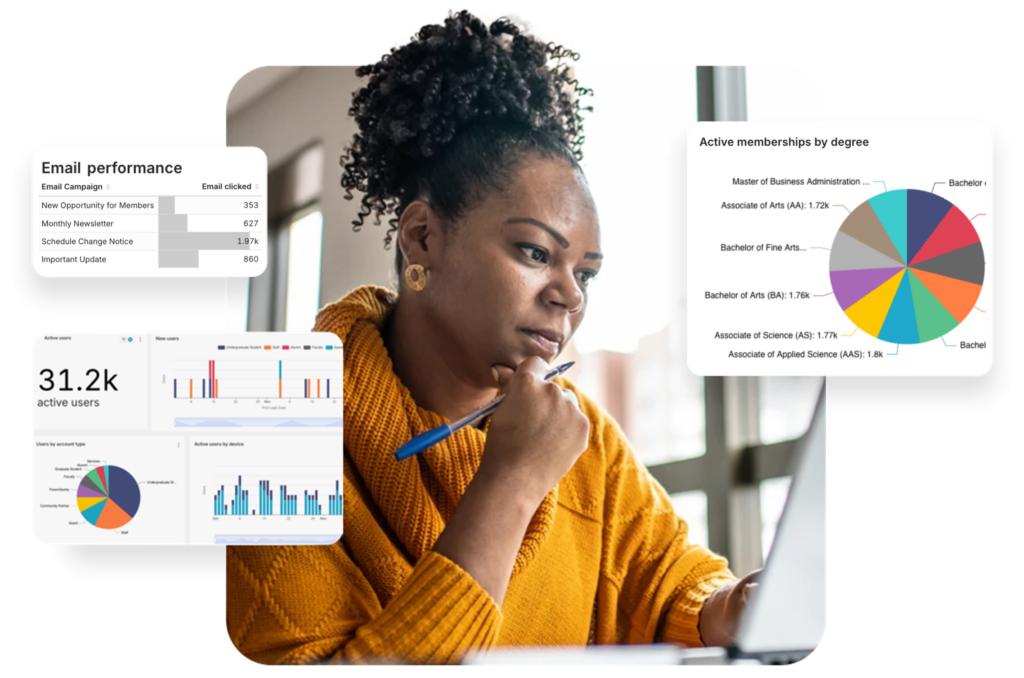
Traditional dashboards answer predefined questions, even though leadership conversations rarely stop at the first question. A dashboard may show declining attendance, but it does not explain why it went down. It may also not reveal which student populations were affected or answer other contextual questions asked during meetings. This is where analytics in higher education is evolving. The future lies in more accessible data.
From Dashboards and Reports to Conversational Insights
Historically, data has been something leaders read. They reviewed charts, tables, filters, and reports until they finally found what they needed. Finding insights required navigating layers of information. In other words, the burden was on the user.
Artificial intelligence changes that model. Data can now become conversational. Instead of searching through dashboards, leaders can ask questions directly. Instead of waiting for new reports, they can explore answers immediately.
Imagine asking:
- When is the best time to schedule events for student athletes?
- Which clubs are attracting the most first-year students?
- Which types of students hold the most leadership positions on campus?
These are not reporting requests. They are conversations. This shift changes how institutions interact with data. If leaders can ask a question during a meeting, they should ask the same question of their data.
The next generation of analytics is conversational, interactive, and exploratory.
The Future of Student Engagement Decision-Making
The institutions that succeed will not simply collect more data. They will understand and act on data faster. Artificial intelligence creates new opportunities to improve student engagement and student success.
Success depends on more than technology. It requires trusted data, institutional context, and responsible design. When those elements come together, institutions gain more than analytics.
The real value of AI is turning insight into action with confidence.
Introducing AI Insights
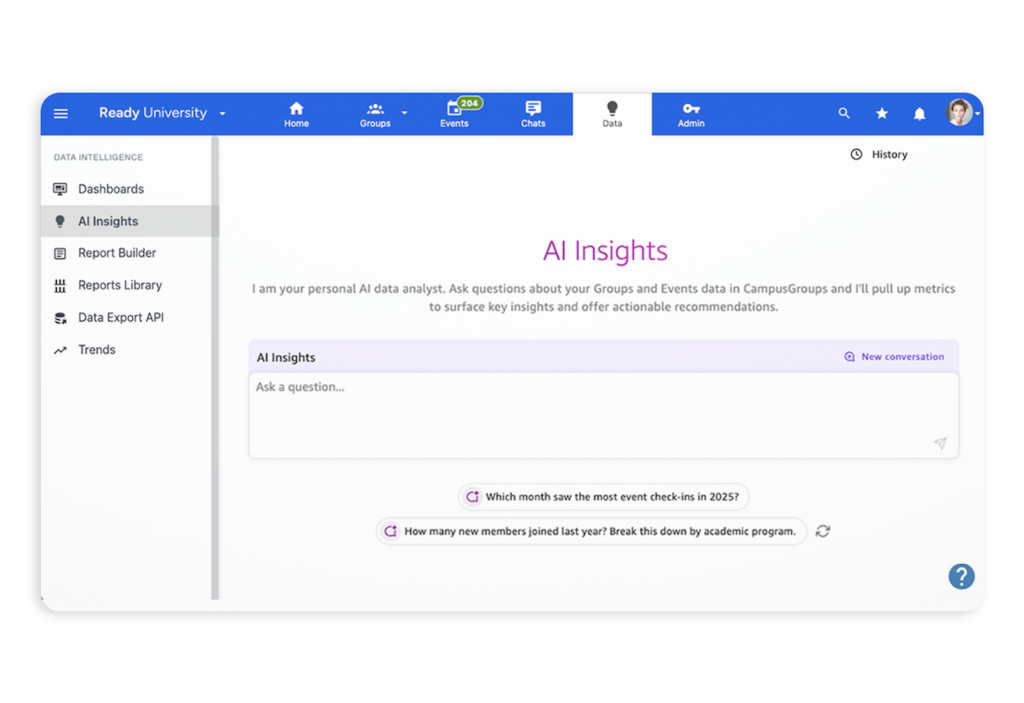
AI Insights is part of CampusGroups Data Intelligence™, built specifically for higher education institutions. It combines artificial intelligence with the engagement context captured across the CampusGroups student engagement platform.
Institutions can ask questions using natural language. They can uncover patterns, explore trends, and generate insights more quickly. AI Insights functions like an on-demand AI data analyst. It helps leadership teams move from waiting for reports to receiving answers in moments. The result is faster decision-making and greater confidence in the data.
The ultimate goal of using AI in higher ed is to improve the student experience and student success.
Learn More About CampusGroups Data Intelligence™
CampusGroups Data Intelligence™ helps institutions centralize engagement data, uncover meaningful insights, and make informed decisions. Discover how AI Insights can help your institution transform student engagement data into action.
Learn more about CampusGroups Data Intelligence™ and the CampusGroups student engagement platform.