-1740583686.svg "Ready Education")

CampusLife at ESCP: Enhancing Student Engagement Across 6 Campuses
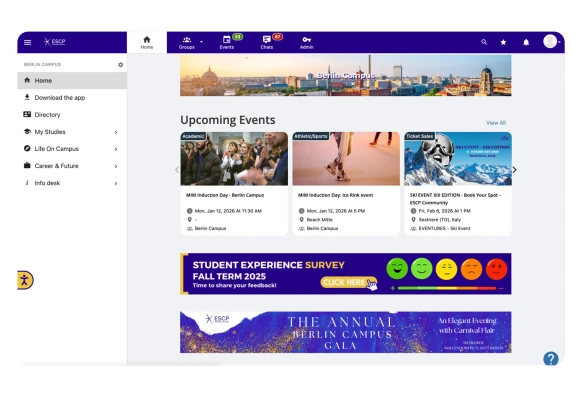
ESCP Business School implemented a unified engagement platform to streamline the student experience across six countries and modernize communication and operations. Branded “ESCP CampusLife,” the system brings multiple hubs into one integrated environment, now serving more than 20,700 active users across Europe.

About ESCP
Founded in 1819, ESCP the world’s first business schools operates a uniquely international model: students rotate between campuses every six months, studying in Berlin, London, Madrid, Paris, Turin, and Warsaw. This global structure offers unparalleled mobility—but also significant logistical challenges, especially in communication, resource access, and student engagement.
Outcomes
Since launching the ESCP CampusLife platform, powered by CampusGroups, in June 2024, ESCP has seen strong adoption and measurable results. Key improvements include enhanced engagement and increased operational efficiency, reflected in:
Challenges
Before ESCP CampusLife, each campus operated a different mix of tools—including event and calendar management tools, Google Forms, separate systems for grades and schedules, and local involvement platforms. This fragmentation created several problems:
Disjointed student experience across countries, programs, and departments.
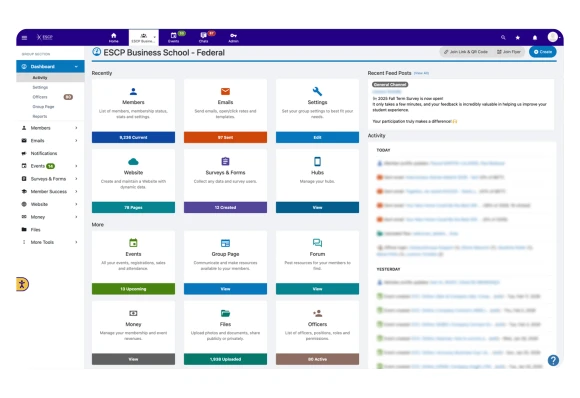
Multiple platforms and no single source of truth, causing confusion and duplicated work.
Lack of unified data, making it difficult to track engagement or identify student needs.
Varied processes across campuses, limiting collaboration and standardization.
Solutions
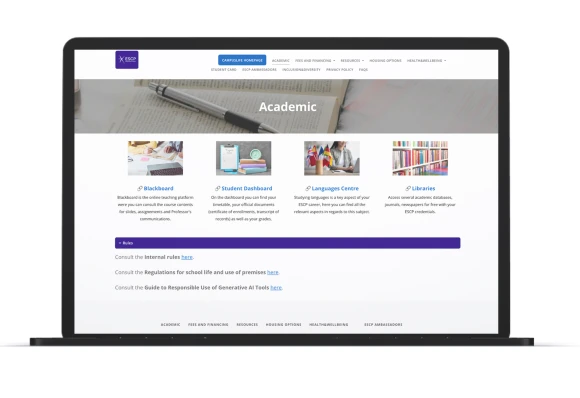
CampusGroups provided ESCP with a branded, centralized, scalable platform flexible enough to support:
Multi-campus structures.
Multi-program pathways.
Localized content.
Deep integrations (SIS/API).
Consistent student experience.
Why Implementation Succeeded
ESCP CampusLife succeeded thanks to strong leadership, clear structure, and a coordinated rollout led by the Student Experience Federal Directorate with IT support. Key enablers included:
Phased, Campus-by-Campus Rollout – The first campus served as the model, followed by a unified framework of one federal hub and five localized hubs.
Collaborative Buildout – Each campus tailored content and workflows while following shared standards.
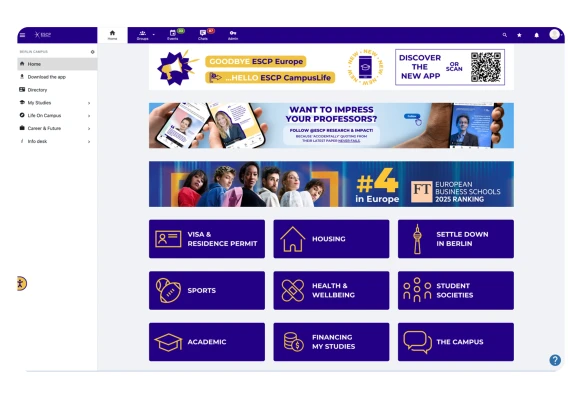
Custom Student Experience – Dynamic user tags were created and used to create a seamless and personalized experience for each student.
Cross-Campus Training – Hands-on sessions aligned staff, faculty, and student leaders across all regions.
Student-Led Branding – Students named and shaped ESCP CampusLife, driving ownership and excitement.
Shared Best Practices – High-performing campuses informed scalable approaches across Europe.
Standardized Adoption – All student societies now use ESCP CampusLife for events and group management.
Consistent Communication – Campus-wide campaigns reinforced awareness and ensured sustained engagement.
Additional Outcomes
ESCP CampusLife has strengthened engagement, communication, and operational efficiency across ESCP’s five campuses:
Universal Society Adoption – All 193 student groups now manage events and activities in one place.
Improved Communication – Targeted emails from administrators and student orgs see higher open and engagement rates.
Higher Event Participation – Reminders, and a unified events hub boost attendance.
Cross-Campus Alignment – Teams share workflows and best practices across countries for stronger collaboration.
Operational Efficiency – Consolidating legacy tools reduces redundancy and streamlines processes.
Growing Departmental Use – Additional academic and administrative units are joining after seeing early results.
Key Features Driving Impact – Events & check-ins, group management, automated workflows, email analytics, personalized dashboards, and connection programs.

Conclusion
ESCP CampusLife has transformed the student experience, consolidating systems, standardizing processes, and connecting five campuses through one shared, mobile-first platform. With deeper integrations, strong adoption, and growing cross-campus collaboration, ESCP is positioned to continue expanding its use of CampusGroups to enhance communication, streamline operations, and improve student success across Europe.
Relate to the challenges in this case study?
Discover how our solutions can address your real-world challenges and transform outcomes for student success.